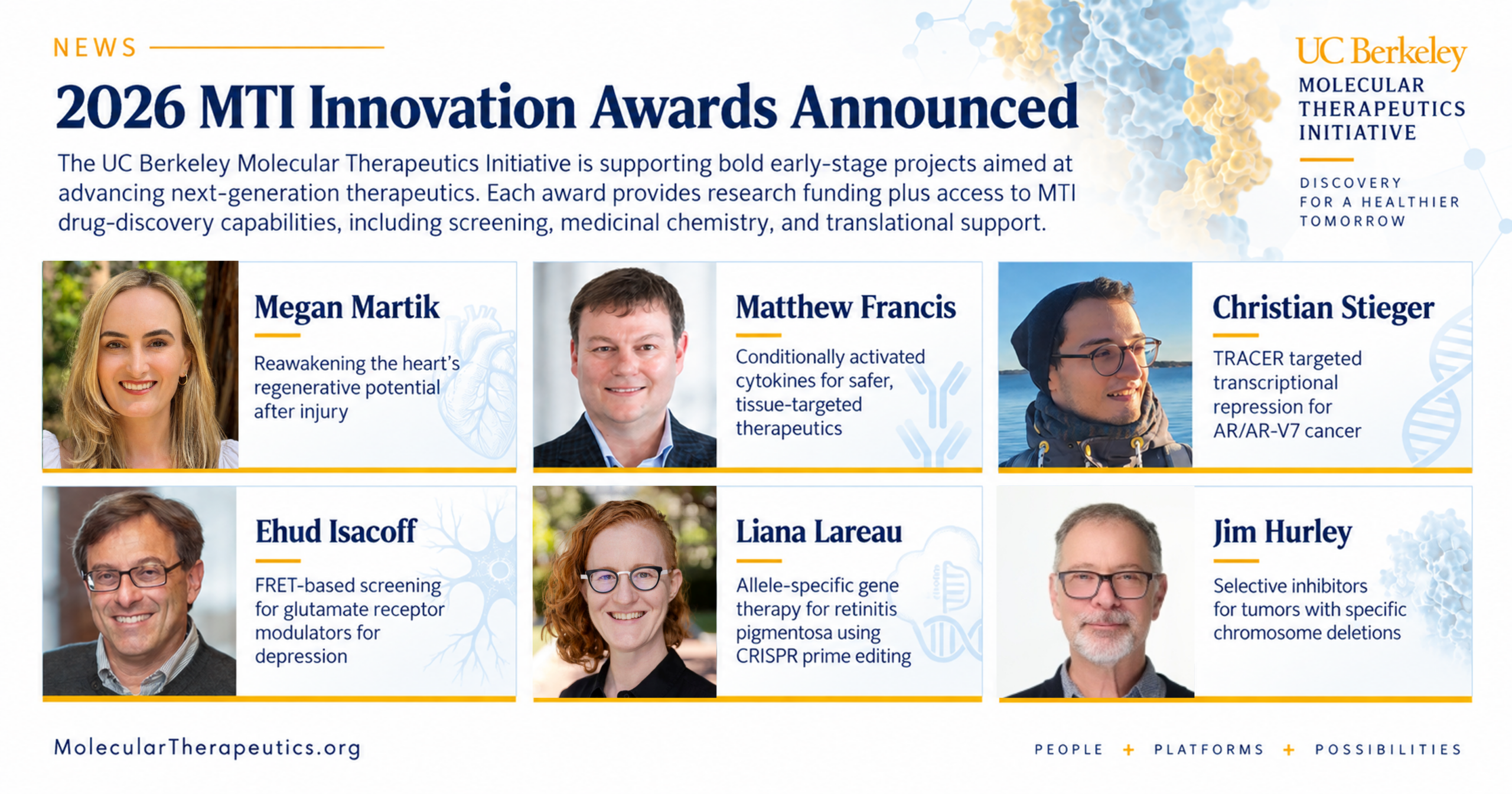
UC Berkeley’s Molecular Therapeutics Initiative backs new ideas on heart repair, cancer, depression and more
The 2026 MTI Innovation Awards are designed to move promising academic discoveries toward medicines, technologies and potentially new companies — while giving Berkeley trainees experience in real-world drug discovery.
Some of the most potentially transformative ideas in medicine begin with discoveries that are still too early for a pharmaceutical company to pursue and too applied for many traditional basic-research grants.
UC Berkeley’s Molecular Therapeutics Initiative (MTI) is trying to close that gap.
Through its 2026 Innovation Awards, MTI is supporting a group of Berkeley researchers pursuing new approaches to some of medicine’s most persistent problems: repairing damaged heart muscle, making powerful protein drugs safer, switching off previously “undruggable” cancer drivers, developing new antidepressants, treating inherited blindness and exploiting vulnerabilities in cancer cells.
The awards are intended not simply to fund another year of academic research, but to help researchers answer the questions that determine whether an idea can become a therapeutic program. Each project receives $90,000 in direct research funding for one year, with the possibility of renewal if agreed-upon milestones are met, along with access to MTI drug-discovery infrastructure such as high-throughput screening and medicinal chemistry.
That combination is central to MTI’s mission: taking discoveries emerging from Berkeley laboratories and subjecting them early to the kinds of experiments normally encountered much later in commercial drug development. MTI was created specifically to connect Berkeley’s strength in fundamental disease biology with technologies and expertise needed to turn biological insights into potential medicines.
The approach can also create a bridge between academic research and California’s biotechnology economy. Not every project will become a drug or a company, nor should it. But projects that generate convincing proof-of-concept data can become candidates for larger translational grants, industry partnerships, licensing or startup formation. MTI reports that spinout companies founded by its members have collectively raised more than $1 billion in venture capital.
“Berkeley generates extraordinary fundamental science. The Innovation Awards let us take some of those discoveries one step further: build the assay, make the molecule, test the mechanism and generate the evidence needed to decide whether there is a real therapeutic opportunity.”
— Daniel Nomura, MTI Faculty Co-Director
Reawakening the heart’s ability to repair itself
Megan Martik, an assistant professor of molecular and cell biology, is asking a deceptively simple question: Why can some animals repair an injured heart while humans largely cannot?
After a heart attack, the adult human heart replaces damaged muscle predominantly with scar tissue. Martik’s research examines genetic programs that allow regenerative animals to rebuild functional heart tissue and asks whether related programs, which appear to remain present but inactive in humans, might be switched back on. Her team will use human stem-cell models to explore ways of restoring some of the heart’s latent regenerative capacity.
If successful, the work could point toward a fundamentally different way of treating heart disease: not simply limiting damage after a heart attack, but eventually helping the heart replace lost muscle.
Powerful protein drugs that turn on only where they are needed
Matthew Francis, professor of chemistry, is tackling a longstanding problem with cytokines — proteins capable of dramatically altering immune activity.
Their potency makes cytokines attractive therapeutics, but it can also make them toxic when they circulate throughout the body. Francis’ team is developing a molecular switch designed to keep a cytokine inactive while it travels through the bloodstream and activate it only after it reaches inflamed tissue.
The broader significance is the platform itself. If the switching mechanism proves robust, the same principle could potentially be adapted to other protein drugs, allowing potent therapies to act preferentially at diseased tissue while reducing effects elsewhere.
Switching off cancer programs once considered undruggable
Christian Stieger is advancing MTI’s TRACER technology to address a different class of difficult therapeutic targets.
Many proteins that drive cancer work by controlling gene expression but lack the obvious pockets that conventional drugs bind. The project instead aims to recruit the cell’s own gene-silencing machinery directly to these cancer-driving proteins, effectively shutting down the harmful genetic programs they control.
The initial work focuses on androgen receptor-driven prostate cancer, including forms driven by AR-V7 that can contribute to treatment resistance. At the same time, the team is building a high-throughput discovery system to identify simpler, drug-like molecules capable of producing the same transcriptional repression.
If the strategy works broadly, it could provide a new route to drug targets that conventional medicinal chemistry has struggled to reach.
A different way to search for antidepressants
Ehud Isacoff, professor of molecular and cell biology, is developing a screening technology aimed at glutamate receptors, which are increasingly being explored as targets for faster-acting antidepressants.
Instead of simply measuring whether a compound binds a receptor, the system uses an optical technique known as FRET to detect changes in the receptor’s structure. That could allow researchers to distinguish compounds that alter specific receptor subtypes and conformations — potentially identifying drugs with the desired antidepressant activity while reducing unwanted effects. MTI project summary
The work addresses an important limitation of existing depression treatments: many patients do not respond adequately, and successful treatments can take weeks to produce their full effect.
Precision gene editing for inherited blindness
Liana Lareau, associate professor of bioengineering, is developing an allele-specific gene therapy for retinitis pigmentosa using CRISPR prime editing.
The strategy is designed to correct disease-causing genetic variants while preserving the healthy copy of a patient’s gene — an approach that could ultimately provide a highly precise treatment for inherited retinal disorders. Lareau’s project was among the programs selected through MTI’s Innovation Award program as it expanded into new therapeutic modalities.
Finding drug vulnerabilities created by cancer itself
Jim Hurley, professor of molecular and cell biology, is combining high-resolution structural biology with medicinal chemistry to exploit genetic vulnerabilities in tumors.
His work uses cryo-electron microscopy to guide the design of selective inhibitors aimed at cancers carrying particular chromosome deletions. The underlying concept is precision medicine in a particularly direct form: use a genetic change that helped create the tumor to reveal a vulnerability that normal cells do not share.
Training scientists to think beyond the publication
“Translation is also training. Students and postdocs learn what it takes to move from an interesting biological result to something that could actually become a drug, a platform or a company. Those are skills they carry into California’s biotechnology ecosystem.”
— Roberto Zoncu, MTI Faculty Co-Director
The Innovation Awards also serve a second function: exposing graduate students, postdoctoral researchers and other trainees to the practical decisions involved in turning a biological discovery into a therapeutic program.
Academic training traditionally emphasizes discovering something new and publishing it. Translational research adds a different set of questions: Can the biology be reproduced in a screening assay? Can a compound reach the target? Is the effect selective? Can the molecule be improved? Is there a path to manufacturing, intellectual property, clinical development or commercialization?
Working through those questions gives trainees experience that is directly relevant to careers in biotechnology, pharmaceutical research and entrepreneurship. MTI has made this type of practical drug-discovery training an explicit part of its broader mission.
And, when a project does prove capable of moving beyond the university, the impact can extend beyond a scientific publication. University discoveries can become licensed technologies or new companies, attracting private investment and creating scientific and technical jobs in California. Berkeley’s broader innovation ecosystem has repeatedly demonstrated that fundamental academic discoveries can become the basis of new biotechnology companies and, ultimately, new medicines.